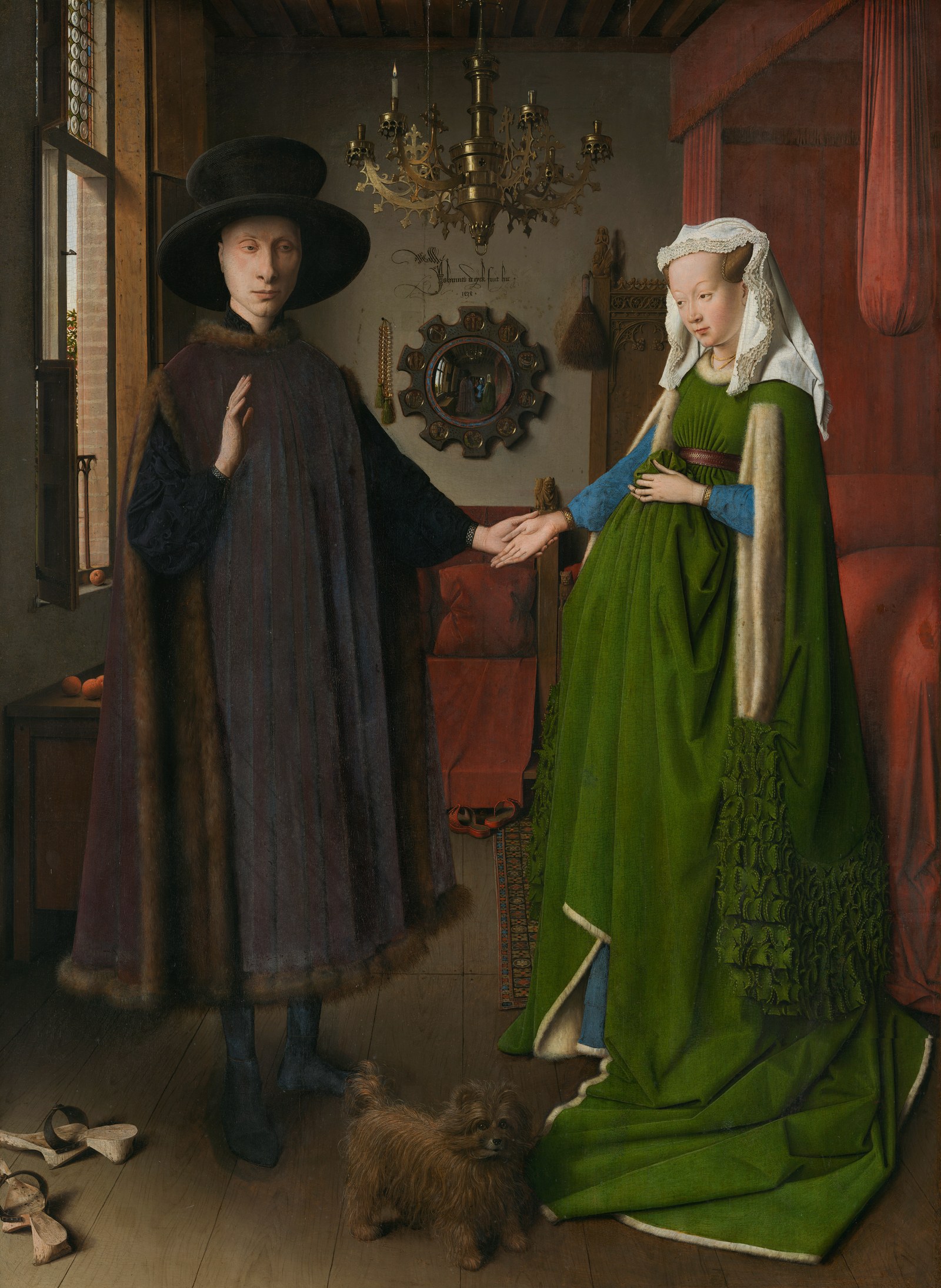
The Arnolfini Portrait
1434Oil on oak panel82.2 × 60 cmNational Gallery, London, United Kingdom
The story
Few paintings hide as many secrets as this small oak panel. In 1434 Jan van Eyck painted a wealthy couple standing in their room in Bruges: Giovanni di Nicolao Arnolfini, a merchant from Lucca, and his wife. For centuries the picture was known as "The Arnolfini Wedding", and it is still one of the most discussed paintings in the history of art.
Look at their hands. The man raises his right hand as if taking an oath, while in his left he holds the hand of his wife. Many scholars have read this as the moment of a marriage vow – in the fifteenth century a couple needed neither a priest nor a church to marry; the promise itself was enough. That he takes her hand with his left, not his right, has even been explained as a sign that the bride came from a lower social rank.
Then look at the mirror on the back wall. In it we see the couple from behind – and two more figures standing in the doorway, exactly where we, the viewers, stand. One of them may be the painter himself. Above the mirror, in elegant Latin letters, he wrote "Johannes de eyck fuit hic 1434" – "Jan van Eyck was here, 1434". It reads almost like the signature of a witness.
Nearly every object seems to speak. The single candle burning in daylight has been read as the presence of God; the little dog as faithfulness and wealth; the oranges by the window – rare and costly fruit in the North – as a sign of luxury; the shoes left on the floor as a reminder that this is sacred ground. The woman is not pregnant, as many think at first sight: she is gathering the heavy folds of her fashionable dress, and that rounded silhouette was the ideal of beauty at the time.
Today many historians doubt that we are really watching a wedding. Some see a portrait of a married couple that records their status and wealth; others a memorial – Arnolfini's first wife, Costanza, died in 1433, a year before the date on the wall. The painting keeps its secret, and perhaps that is why we keep coming back to it.
Interesting facts
The ten tiny medallions around the convex mirror show scenes from the Passion of Christ.
Before it reached London, the painting belonged to Habsburg rulers and hung for centuries in the Spanish royal collection. The National Gallery bought it in 1842.
Van Eyck built the picture from thin, transparent layers of oil paint – that is how he achieved details such as the dog's fur, the glow of the brass chandelier and the reflections in the mirror.